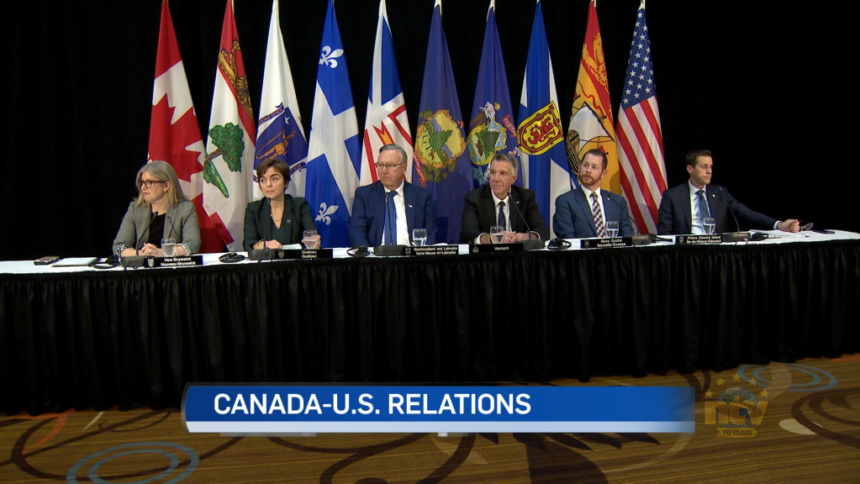
The clock had barely struck nine when the four Atlantic premiers settled into their meeting room at the Sheraton Hotel in downtown St. John’s. The morning fog still clung to Signal Hill as they prepared to discuss a storm brewing south of the border – one that could hit Atlantic Canada’s economy harder than any Newfoundland nor’easter.
“We’re deeply concerned about the potential impact of these tariffs on our region’s manufacturing and resource sectors,” said Nova Scotia Premier Tim Houston, his usually measured tone carrying a hint of urgency. “When Atlantic Canada’s economies face external pressure, we need to stand united.”
The premiers gathered Tuesday for their regular Council of Atlantic Premiers meeting, but this time with added urgency. Former President Donald Trump’s recent campaign pledge to implement sweeping tariffs of 10-20% on Canadian goods if re-elected has cast a shadow over their agenda. This threat comes as Vermont Governor Phil Scott publicly criticized the tariff proposal, calling it “counterproductive” to both American and Canadian interests.
New Brunswick Premier Blaine Higgs, whose province sends roughly 90% of its exports to the U.S., didn’t mince words. “We’ve weathered trade disputes before, but these proposed tariffs would affect everything from our seafood to our lumber. That’s thousands of jobs across communities that depend on stable trade relationships.”
The four leaders – Houston, Higgs, Newfoundland and Labrador’s Andrew Furey, and Prince Edward Island’s Dennis King – represent a region where cross-border trade isn’t just about economics, but about generations of interconnected communities.
Statistics Canada data shows the Atlantic provinces exported approximately $19.8 billion in goods to the U.S. in 2022. Even a 10% tariff could mean nearly $2 billion in additional costs for regional businesses – costs that would inevitably be passed to consumers on both sides of the border.
“This isn’t just about balance sheets,” Premier Furey told reporters during a mid-morning break. “It’s about families in Marystown, Corner Brook, and St. John’s who depend on access to American markets. We’re preparing a coordinated response that protects Atlantic workers.”
What makes the situation particularly frustrating for Atlantic leaders is the timing. The region has been working to diversify its economic base after pandemic disruptions revealed vulnerabilities in supply chains. The uncertainty around future trade relations complicates this recovery.
Prince Edward Island’s Premier King, whose province depends heavily on agricultural exports, pointed to a potential silver lining. “This threat reinforces why we’ve been pushing for more regional cooperation. Maybe it’s time we look at strengthening inter-provincial trade as a buffer against international uncertainty.”
The premiers’ concern found unexpected support from Vermont Governor Scott, who shares a border with Quebec and understands the deep connections between the two countries. In a statement released Monday, Scott emphasized that “trade wars benefit no one” and called for cooperation rather than confrontation.
“When a Republican governor from a border state speaks out against these tariffs, it tells you something about how problematic they would be,” noted Dalhousie University economics professor Martha Stevens. “Vermont and Atlantic Canada share similar rural economies that depend on cross-border movement of goods and services.”
The Atlantic premiers are exploring several contingency strategies. Sources close to the discussions indicate they’re considering everything from accelerated market diversification to potential subsidy programs for vulnerable industries. They’re also planning coordinated advocacy with border state governors who share their concerns.
Community impacts remain at the forefront of their discussions. In towns like St. Stephen, New Brunswick – which sits directly across from Calais, Maine – the border is more theoretical than practical. Families live on both sides, businesses serve both communities, and workers cross daily.
“You can’t just redraw economic relationships that go back generations,” said Jamie Thompson, who runs a seafood processing plant in southwestern Nova Scotia that employs 120 people. “We send 80% of our product to Boston and New York. There’s no quick pivot if those markets suddenly become more expensive.”
Back in the meeting room, staff hurried in with fresh data from provincial trade departments. The mood was serious but determined. Premier Furey, as host, emphasized that their response needed to balance immediate protection with long-term planning.
“The federal government needs to hear a unified Atlantic voice on this issue,” he said. “We represent smaller populations, but our trade relationships are vital to both countries.”
As the afternoon session began, the premiers shifted to practical matters: which industries would need immediate support, which alternative markets offered the best opportunities, and how to coordinate their message to federal counterparts in Ottawa.
What emerges from this meeting will likely set the tone for Atlantic Canada’s approach to potential trade disruptions in the coming year. Whether Trump’s tariff threats materialize or not, the premiers know that preparation is essential.
“This isn’t our first trade challenge with our American neighbors,” Premier Higgs reflected, “and I suspect it won’t be our last. But Atlantic Canadians are resilient. We’ll find a path forward, together.”
As the meeting concluded and the premiers prepared for their joint press conference, one thing was clear: the four Atlantic provinces may be small individually, but their united response to external threats demonstrates why regional cooperation matters now more than ever.