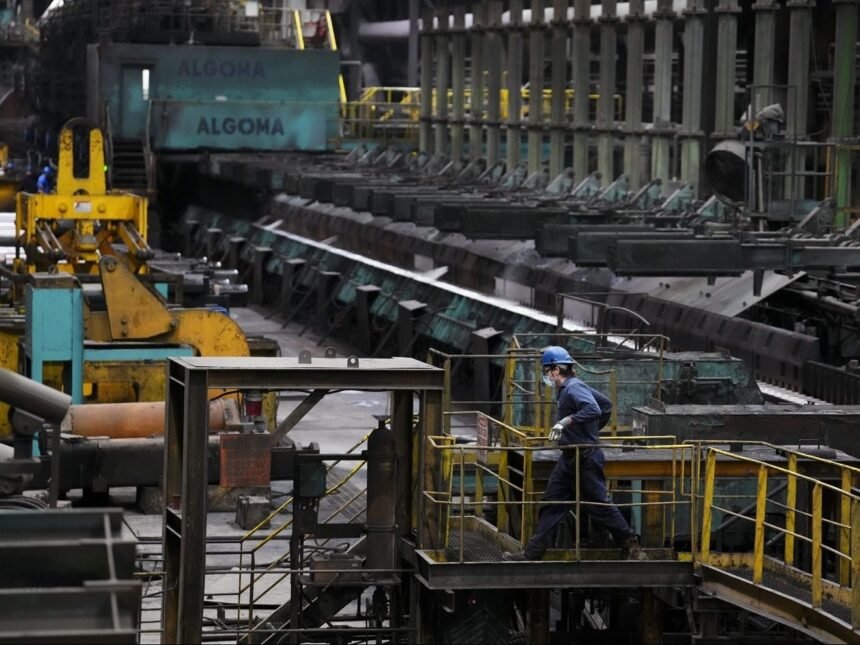
Algoma Steel’s recent layoff announcement puts a human face on the abstract trade policies that are rapidly reshaping the Canadian manufacturing landscape. The Sault Ste. Marie operation has issued pink slips to roughly 1,000 workers – about 40% of its workforce – citing crushing pressure from American steel tariffs.
This isn’t just another corporate restructuring. For a city of 70,000 where the steel mill serves as both economic anchor and identity cornerstone, these cuts represent a community crisis in the making.
“We’ve survived tough times before, but this feels different,” says Marco Belluzzo, a third-generation steelworker who received his notice last week. “My father weathered the restructuring in the 90s, and my grandfather saw the ups and downs before that. But these tariffs are squeezing us in ways we haven’t experienced.”
The immediate trigger for the layoffs is a 25% tariff on Canadian steel imposed by the U.S. in 2018. While some exemptions were granted, the protective measures have significantly reduced Algoma’s access to American markets where it historically shipped about 70% of its output.
Chief Executive Michael Garcia didn’t mince words in the company’s statement: “Despite our best efforts to maintain operations at full capacity, the continued trade barriers have made our current staffing levels unsustainable.”
The numbers tell a stark story. Algoma’s quarterly filings show U.S. shipments down 32% compared to pre-tariff levels, while production costs have climbed nearly 18% due to inflation and energy prices. The combination has squeezed margins to breaking point.
Industry analysts had been anticipating cuts, though the scale surprised many. “We expected workforce reductions in the 400-500 range,” notes Patricia Mohr, former commodity market specialist at Scotiabank. “The decision to cut deeper suggests management sees these market conditions persisting longer than initially thought.”
The timing couldn’t be worse for workers. Winter in northern Ontario brings added financial pressure from heating costs, while the approaching holiday season amplifies the emotional toll.
Local union representatives are scrambling to negotiate transition packages, but options remain limited in a specialized industry. “These aren’t jobs you can easily replace in our community,” says Marty Warren, Ontario director for the United Steelworkers. “When you’ve spent 20 years developing skills specific to steel production, pivoting to another industry isn’t simply a matter of retraining.”
The ripple effects will extend well beyond the plant gates. Economic multiplier studies suggest each steel job supports between 3-7 additional positions in the community. Local businesses from restaurants to retail shops are bracing for the impact as disposable income evaporates.
“We’re already seeing customers cutting back,” says Elena Provenzano, who owns a popular café two blocks from the mill. “People are being careful with their money, canceling the small luxuries first. My weekday morning rush is half what it was last month.”
City officials are working to assemble an economic response package, but municipal resources are limited. Mayor Matthew Shoemaker has called on both provincial and federal governments to step in with emergency assistance.
The situation highlights Canada’s vulnerability in the shifting landscape of global trade. Despite the USMCA agreement that replaced NAFTA, sectoral tariffs remain a powerful tool that can upend communities dependent on cross-border commerce.
Economic Development Minister Vic Fedeli acknowledged the severity of the situation: “We’re working closely with federal counterparts to address both the immediate employment needs and the underlying trade issues that created this crisis.”
What makes the Algoma situation particularly frustrating for Canadian officials is the timing. The steel producer is midway through a $700 million transition to electric arc furnace technology – an environmental upgrade that would reduce carbon emissions by approximately 70% compared to traditional blast furnaces.
“The modernization project represents exactly the kind of green manufacturing transformation both governments claim to support,” explains Rachel Samson, Clean Growth Research Director at the Canadian Institute for Climate Choices. “These layoffs potentially undermine that transition at a crucial stage.”
For workers like Belluzzo, the policy discussions feel removed from the immediate reality. “I understand the big picture stuff about trade and carbon and competitiveness,” he says. “But right now, I’m figuring out how to tell my kids we’re cutting back Christmas and wondering if we’ll need to sell the house come spring.”
Some industry observers see a potential path forward through renegotiation of targeted exemptions. Steel produced for automotive manufacturing already enjoys some protection, and expanding these carve-outs could preserve more Canadian jobs.
“There’s room for a sector-specific approach that recognizes the integrated nature of North American manufacturing,” suggests Dennis Darby, CEO of Canadian Manufacturers & Exporters. “The challenge is making that case effectively in Washington’s current political climate.”
Meanwhile, Algoma workers are left weighing their options in a community where the mill has long been the economic bedrock. Some are considering relocation to southern Ontario, while others are looking at retraining programs offered through the provincial Second Career initiative.
The steel industry has always been cyclical, but the combination of trade barriers, energy transition pressures, and global market shifts has created what Warren calls “a perfect storm” for communities like Sault Ste. Marie.
As winter settles over the north shore of Lake Superior, the steam rising from Algoma’s operations remains a familiar sight. But for many families, the question now is whether this industrial landmark will continue to anchor their futures, or become another chapter in the story of manufacturing’s transformation in North America.