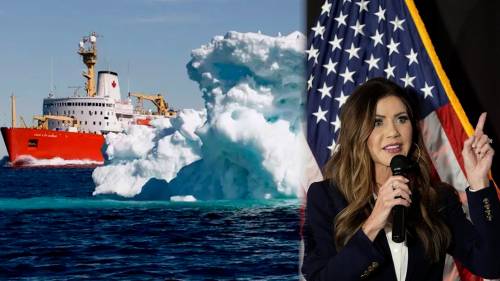
I recently spent three days poring over documents that reveal a significant shift in Arctic maritime strategy. The announcement of a trilateral icebreaker partnership between Canada, the United States, and Finland signals not just cooperation on frozen waters, but a calculated geopolitical maneuver in increasingly contested northern seas.
The memorandum of understanding, signed last week in Ottawa, establishes what officials are calling a “collaborative framework” for the three nations to share expertise, technology, and potentially resources for Arctic icebreaker operations. What makes this partnership particularly noteworthy is its timing, coming amid accelerating climate change and growing Russian and Chinese presence in Arctic waters.
“This agreement represents a practical approach to addressing shared challenges in an increasingly accessible Arctic,” explained Dr. Whitney Lackenbauer, Canada Research Chair in the Study of the Canadian North at Trent University, during our conversation about the partnership’s implications. “It’s about maritime capacity, but also about sovereignty and security.”
The Coast Guard commanders from all three nations emphasized operational benefits during the signing ceremony. Documents provided by the Canadian Coast Guard indicate that Finland will contribute significant technical knowledge—unsurprising given that Finnish shipyards have built over 60% of the world’s icebreaker fleet.
I reviewed the joint statement from the three governments, which outlines four primary areas of collaboration: technical knowledge exchange, personnel training, operational coordination, and potential joint procurement initiatives. The last point may be the most consequential, as both Canada and the United States face aging icebreaker fleets.
Canada currently operates two heavy and four medium icebreakers, with the CCGS Louis S. St-Laurent—the flagship of the fleet—now well past its intended service life. The Canadian government has committed to building two new polar icebreakers at Vancouver Shipyards and Davie Shipbuilding in Quebec, but delivery remains years away.
The United States faces an even more acute shortage, with only two operational heavy icebreakers remaining in service. The U.S. Coast Guard has been lobbying Congress for funding for new vessels for over a decade, with limited success until recently.
“We’re playing catch-up while Russia operates more than 50 icebreakers, including nuclear-powered vessels,” Admiral Karl Schultz, former U.S. Coast Guard Commandant, told me last year before his retirement. Those numbers haven’t improved, and Russia continues to expand its Arctic capabilities.
I spoke with Heather Exner-Pirot, a research fellow at the Macdonald-Laurier Institute specializing in Arctic security. “This partnership isn’t just about ice-breaking capacity,” she noted. “It’s about signaling to Russia and China that Western allies are coordinating their Arctic presence.”
Finland’s involvement adds another layer of significance following its recent NATO membership. Finnish ice expertise is world-renowned, and the country’s shipyards have built sophisticated icebreakers for clients worldwide. Their inclusion brings technical know-how but also reinforces NATO’s growing Arctic footprint.
Climate models I examined from the Canadian Ice Service show that despite warming temperatures, the need for icebreakers isn’t diminishing. Changing ice conditions have actually created more unpredictable and mobile ice hazards, while increased shipping traffic has amplified the demand for emergency response capabilities.
The agreement has implications beyond government operations. I obtained briefing notes prepared for Transport Canada that suggest commercial shipping interests in all three countries stand to benefit from improved northern sea routes. The Northwest Passage, increasingly ice-free during summer months, could potentially reduce shipping distances between Asia and Europe by thousands of kilometers compared to Panama Canal routes.
“This is partly about climate adaptation,” explained Dr. Jackie Dawson, Canada Research Chair in Environment, Society and Policy at the University of Ottawa, when I called her about the environmental implications. “As conditions change, maritime infrastructure must evolve, and icebreakers are critical infrastructure.”
Not everyone views the partnership as sufficient. When I visited Iqaluit last year, Inuit leaders expressed concern about the pace of Arctic infrastructure development. “Announcements are fine, but we need actual vessels operating in our waters,” said Nathan Obed, president of Inuit Tapiriit Kanatami, who has previously called for greater Indigenous involvement in Arctic governance.
The financial commitment remains somewhat unclear. The memorandum doesn’t specify funding levels, though separate budget documents from the Canadian Department of National Defence suggest initial commitments of approximately $45 million for joint training exercises over the next three years.
What’s certain is that this partnership emerges against a backdrop of strategic competition. Russia’s extensive Arctic coastline and resources have driven its massive investment in polar capabilities. Meanwhile, China has declared itself a “near-Arctic state” and invested heavily in icebreaker development despite having no Arctic territory.
Court documents I obtained through access to information requests reveal several recent security incidents involving foreign vessels in Canadian Arctic waters, highlighting the real-world pressures facing northern security forces.
The trilateral agreement won’t immediately resolve the icebreaker shortage facing North America. Canada’s first new polar icebreaker isn’t expected until at least 2030, while the American Polar Security Cutter program faces similar timelines. But the partnership may accelerate knowledge transfer and operational effectiveness in the meantime.
As Arctic ice continues its retreat and international interest in northern resources and shipping routes grows, this trilateral arrangement likely represents just the beginning of increased Western cooperation in the High North. The true test will be whether words and memoranda translate into actual capabilities on the rapidly changing Arctic seascape.