As the rain pounded British Columbia’s Fraser Valley last week, I stood with emergency officials watching recovery teams navigate roads that had disappeared under muddy water just days earlier. The scene was grimly familiar – another climate disaster stretching local resources beyond their breaking point, with provincial officials scrambling to coordinate with federal counterparts.
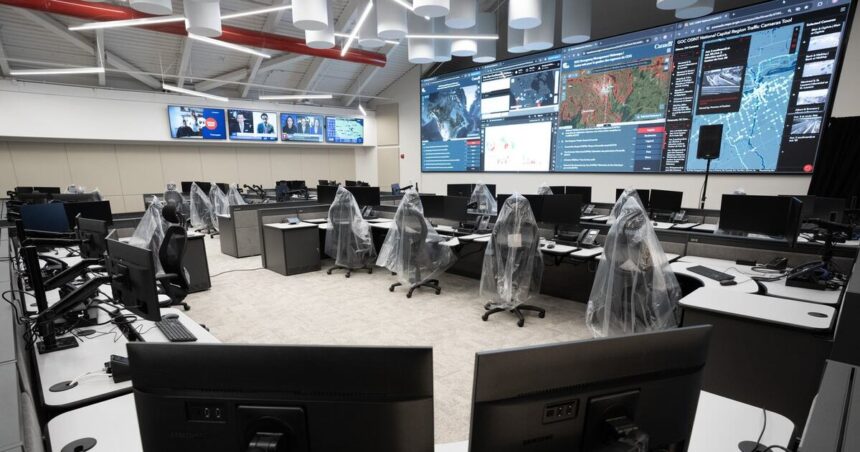
These chaotic emergency responses may soon change. Yesterday, Minister of Emergency Preparedness Harjit Sajjan unveiled the new Federal Disaster Response Coordination Centre (FDRCC) in Ottawa, a $112 million facility designed to transform how Canada manages increasingly frequent climate emergencies.
“The days of jurisdictional finger-pointing during disasters must end,” Sajjan told gathered officials at the ribbon-cutting ceremony. “This centre brings every level of government into one room with real-time data to make decisions that save lives.”
The facility’s opening comes after three consecutive years of record disaster costs. According to Public Safety Canada, federal disaster assistance payments have tripled since 2018, reaching $3.1 billion last year alone.
My tour of the 38,000-square-foot command centre revealed a technological leap from previous systems. Massive digital walls display nationwide weather data, infrastructure status, and emergency resource locations. Staff demonstrated how provincial emergency managers can now share information through secure digital channels rather than the patchwork of phone calls and emails that characterized previous disaster responses.
For communities like Fort McMurray, which faced both devastating wildfires in 2016 and catastrophic flooding in 2020, the centre represents a potential lifeline.
“When you’re watching your town burn or flood, the last thing you need is confusion about who’s in charge,” said former Fort McMurray fire chief Darby Allen, who consulted on the centre’s design. “This facility finally acknowledges what emergency workers have known for years – disasters don’t respect municipal boundaries.”
The coordination hub emerges from the ashes of widely criticized responses to recent disasters, including the 2021 heat dome that killed 619 people in British Columbia. A subsequent coroner’s report highlighted communication breakdowns between different levels of government as contributing factors in the death toll.
However, provincial reactions to the new federal initiative reveal the political tensions that continue to complicate emergency management. While British Columbia and Nova Scotia immediately signed partnership agreements, Alberta Premier Danielle Smith questioned the centre’s mandate.
“We appreciate federal support during emergencies, but Alberta maintains primary jurisdiction over disaster response within our borders,” Smith said in a statement yesterday. “This centre must respect provincial authority.”
The fragmented approach has real consequences. According to an Auditor General report released last month, Canadians in different provinces received vastly different levels of disaster support during similar emergencies, with Quebec residents receiving on average 22% more post-disaster assistance than those in Saskatchewan after comparable events.
The coordination centre attempts to address these disparities through standardized assessment tools and response protocols. During my tour, staff demonstrated “digital twin” technology that creates real-time virtual models of affected communities, allowing precise resource allocation regardless of location.
Yet questions remain about whether technology alone can overcome entrenched political divisions. Former Parliamentary Budget Officer Kevin Page told me the centre represents a “significant step forward in infrastructure” but warned that “without clear authority to direct resources across jurisdictional lines, we may still face coordination challenges.”
Community leaders from disaster-prone regions express cautious optimism. Lytton Mayor Denise O’Connor, whose British Columbia village was 90% destroyed by wildfire in 2021, attended the opening ceremony.
“After watching my community burn in minutes, I’ve seen firsthand how the current system fails people,” O’Connor said. “This centre looks impressive, but what matters is whether it actually speeds up help when the next disaster strikes.”
The facility’s timing coincides with alarming new climate projections. Environment Canada’s latest assessment predicts a 40% increase in extreme weather events by 2030, with disaster-related costs potentially reaching $5 billion annually.
For ordinary Canadians caught in these disasters, jurisdictional debates matter less than results. In High River, Alberta, where flooding displaced 13,000 residents in 2013, small business owner Teresa Matthews remains skeptical.
“They showed us fancy government buildings after our flood too,” Matthews told me by phone. “Eight years later, our insurance rates are still through the roof and we still worry every spring. I’ll believe in better coordination when I see it.”
The centre’s true test will come during the next major disaster. Staff are currently running simulation exercises based on complex scenarios like simultaneous wildfires and flooding across multiple provinces.
As our climate reality grows increasingly unstable, Canadians deserve emergency systems that match the scale of threats we face. This coordination centre represents a significant investment, but the more valuable currency will be trust – something that can only be earned through effective action when the next disaster strikes.
Standing in that command center yesterday, watching emergency officials rehearse responses to simulated crises, I couldn’t help but wonder: will this technological showcase truly translate into safer communities, or will it become another expensive symbol of good intentions without follow-through?
For the families rebuilding in Lytton, the evacuees of Fort McMurray, and coastal communities watching rising seas with growing alarm, that question isn’t academic – it’s existential.