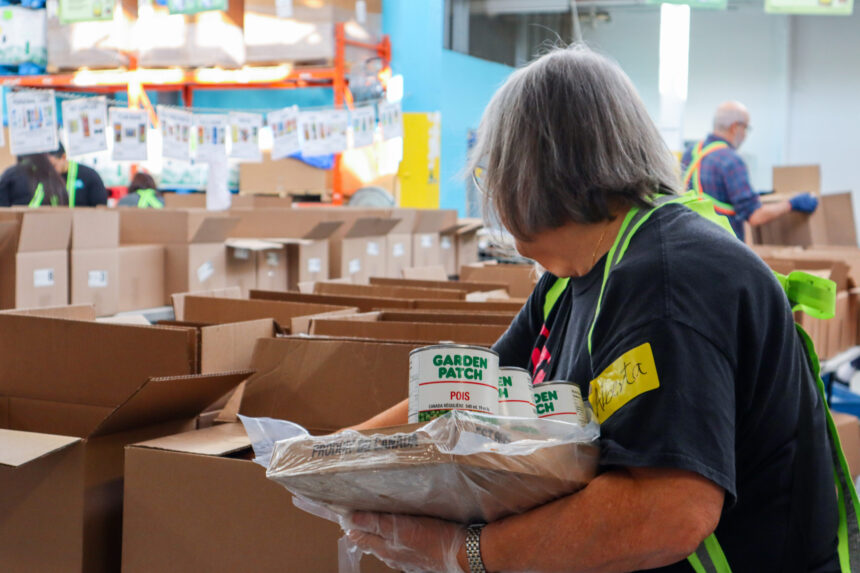
The line outside the Parkdale Community Food Bank stretches nearly a block on this brisk April morning. Among those waiting is Mariana Sousa, a 42-year-old personal support worker who never imagined she’d need food assistance.
“I work full-time, but after rent went up $300 last month, it’s either eat or keep a roof over my kids’ heads,” she tells me, shifting from one foot to another in the morning chill.
Sousa isn’t alone. Food Banks Canada reports a staggering 79% increase in food bank visits since 2019, with more than 2 million Canadians now relying on these services monthly – the highest rate in the organization’s 40-year history. Meanwhile, housing costs continue to consume an ever-larger portion of Canadian incomes.
Against this troubling backdrop, housing advocates are raising alarms about Bill C-37, the federal government’s newly introduced housing legislation. While marketed as relief for the housing crisis, some experts fear it may inadvertently worsen food insecurity for the country’s most vulnerable populations.
“When Canadians spend more than 30% of their income on housing, something has to give – and that something is often food,” explains Dr. Sylvain Charlebois, Director of the Agri-Food Analytics Lab at Dalhousie University. “The relationship between housing affordability and food security is direct and devastating.”
The government touts Bill C-37 as a comprehensive approach to increase housing supply through zoning reforms and infrastructure investments. Prime Minister Justin Trudeau called it “transformative legislation” at last week’s press conference in Vancouver, where home prices remain among North America’s highest.
“We’re taking bold action to build the homes Canadians need,” Trudeau said, highlighting the bill’s provision to free up federal lands for development.
But Ricardo Tranjan, senior researcher at the Canadian Centre for Policy Alternatives, sees critical gaps in the approach. “The legislation focuses almost exclusively on market solutions and supply without adequately addressing affordability guardrails,” he told me during a phone interview.
Tranjan points to what he calls the “missing middle” of Canadian housing policy – insufficient protection for those caught between homelessness and homeownership. “Without strong rent controls and targeted investment in deeply affordable units, increasing supply alone won’t help those most at risk of food insecurity.”
The numbers tell a sobering story. According to Statistics Canada, nearly 16% of Canadians reported experiencing some form of food insecurity in 2022, up from 12.7% in 2018. Among renters, that figure jumps to 28%.
In Ottawa’s Vanier neighbourhood, I meet Jamal Hassan, who runs a small community support network connecting new Canadians with housing and food resources. He’s seen firsthand how housing pressures ripple through families.
“When people pay 50, 60, sometimes 70 percent of income for housing, they come to us for food,” Hassan explains. “But they also cut back on medicine, on winter clothes, on their children’s school supplies. It’s a cascade of impossible choices.”
Housing Minister Sean Fraser defended the legislation in the House of Commons last Tuesday, emphasizing that the bill represents just one part of the government’s broader housing strategy. “This bill works alongside our investments in co-ops, non-profits, and indigenous housing to ensure all Canadians have a safe and affordable place to call home,” Fraser stated.
But Leilani Farha, global director of The Shift and former UN Special Rapporteur on the Right to Housing, isn’t convinced the current approach will reach those most in need.
“When we talk about housing as a human right, that means ensuring housing is adequate, accessible and affordable for everyone,” Farha says. “The current legislation doesn’t sufficiently protect against financialization of housing that’s driving both unaffordability and food insecurity.”
The relationship between housing costs and food insecurity shows up starkly in provincial data. In British Columbia, where housing costs remain Canada’s highest, food bank use increased by 91% between 2019 and 2023, according to Food Banks BC. Ontario saw an 86% increase during the same period.
Back at the Parkdale food bank, volunteer coordinator Mei Lin Wong says they’re struggling to keep pace. “Three years ago, we served maybe 200 families weekly. Now it’s over 500, and many are working families who simply can’t afford both rent and groceries.”
Conservatives have criticized the bill from a different angle, with housing critic Scott Aitchison calling it “more bureaucracy and empty promises.” The NDP, meanwhile, is pushing for amendments that would add tenant protections and dedicated funding for non-market housing.
As Parliament debates the legislation, experts like Steve Pomeroy, Senior Research Fellow at Carleton University’s Centre for Urban Research, suggest practical fixes. “The bill should include explicit targets for deeply affordable units and stronger incentives for purpose-built rental development,” Pomeroy recommends.
For people like Sousa, these policy debates have real consequences. She shows me her food bank allotment – pasta, canned vegetables, powdered milk, and a few fresh items. “This helps, but it’s not enough,” she says. “And it’s humiliating to work so hard and still not be able to feed your family properly.”
The federal budget, released last month, earmarked $1.6 billion over four years for various housing programs. But critics note this pales in comparison to the scale of investment seen in the 1970s and ’80s, when Canada built significantly more social housing.
“We’re approaching this crisis with teaspoon solutions when we need buckets,” says Garima Talwar Kapoor, Policy Director at Maytree Foundation, which focuses on poverty reduction. “Without substantial investment in deeply affordable housing, we’ll continue seeing record food bank use.”
As debate over Bill C-37 continues in Parliament, Canadians like Sousa find themselves caught between competing necessities. Housing Minister Fraser maintains that increasing supply will eventually moderate prices across the market. But for millions of Canadians making impossible choices between rent and groceries, eventually may not be soon enough.
“I don’t need politicians to promise me affordable housing five years from now,” Sousa says, tucking her food bank items into a reusable bag. “I need to both eat and have shelter today.”