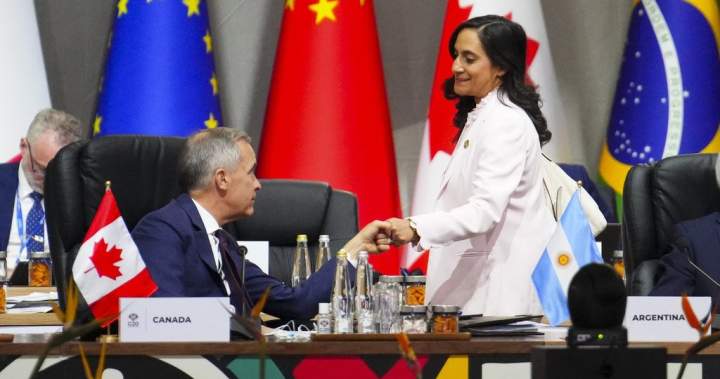
Mark Carney’s recent announcement signaling a recalibration of Canada’s feminist foreign policy approach has sparked debate across Ottawa’s political landscape. The former Bank of Canada governor, now serving as a key policy architect for the Liberal Party, outlined a pragmatic evolution rather than abandonment of gender equality principles in international relations.
At a Canadian Club luncheon yesterday, Carney emphasized that gender considerations would remain “embedded in everything we do” but suggested the terminology and implementation would shift toward more measurable outcomes. The move represents a subtle but significant adjustment to a cornerstone initiative introduced under Prime Minister Justin Trudeau’s government in 2017.
“This isn’t about retreating from our values,” Carney told the audience of business and policy leaders. “It’s about ensuring our approach delivers tangible results for women and girls in conflict zones and developing economies while maintaining strong relationships with our allies.”
The existing feminist foreign policy framework has channeled approximately $650 million toward international gender equality initiatives since its inception, according to Global Affairs Canada data. Projects have ranged from supporting women’s entrepreneurship in Southeast Asia to combating gender-based violence in humanitarian crises.
Political reaction has been predictably divided. Conservative foreign affairs critic Michael Chong welcomed the shift, calling the current approach “more about symbolism than substance.” Meanwhile, NDP Leader Jagmeet Singh expressed concern about potential funding cuts to women-focused international programs, warning against “rebranding that masks a retreat from gender equality commitments.”
For Sarah Davidson, director of the Centre for Global Governance at the University of Ottawa, the recalibration reflects broader tensions in Canadian foreign policy. “The Liberals are trying to navigate competing priorities – maintaining progressive values while addressing criticism that Canada’s stance has sometimes complicated diplomatic relationships with countries that don’t share the same gender equality vision,” Davidson explained in a phone interview.
The policy adjustment comes amid shifting global dynamics, particularly growing competition with China and Russia’s continuing war in Ukraine. Recent polling by Angus Reid indicates that 63% of Canadians prioritize security and economic partnerships over human rights promotion in international relations – up from 47% in 2019.
Women’s rights organizations have responded with measured skepticism. Karen Williams, executive director of Women’s Global Action Network, acknowledges the need for policy evolution but warns against backsliding. “The terminology matters less than the resources and political will behind it,” Williams said. “We’ll be watching closely to ensure this isn’t just a rhetorical shift that undermines gender equality funding.”
Carney’s remarks suggest a more integrated approach where gender considerations become one element of broader foreign policy objectives rather than a separate branded initiative. This parallels approaches taken by countries like Sweden and France, which have incorporated gender equality metrics into traditional diplomatic and development frameworks without distinct feminist foreign policy branding.
For residents in communities like Thunder Bay, where I spoke with voters last week, international policy often feels distant from daily concerns. “I care about equality, but I’m more focused on affordability right now,” said Diane Legault, 47, a healthcare worker. “The government needs to show how these policies actually help regular Canadians.”
The timing of this policy adjustment, coming as the Liberals trail in polls heading toward a potential 2025 election, hasn’t escaped political observers. Carney, widely rumored as a future leadership contender, may be positioning himself and the party for broader electoral appeal by recalibrating policies that have drawn criticism from centrist and conservative voters.
Experts note that Carney’s approach represents a balancing act rather than an ideological reversal. “He’s signaling continuity in values while acknowledging the need for evolution in implementation,” explained Robert McIntosh, former Canadian ambassador and senior fellow at the Canadian Global Affairs Institute. “The question is whether this will translate into more effective policy outcomes or simply different branding.”
As the policy details emerge in coming weeks, the true measure will be whether this shift enhances or diminishes Canada’s influence on global gender equality. For now, Carney’s announcement suggests a government seeking to maintain progressive principles while adapting to a complex international landscape where security concerns and economic partnerships increasingly dominate the agenda.