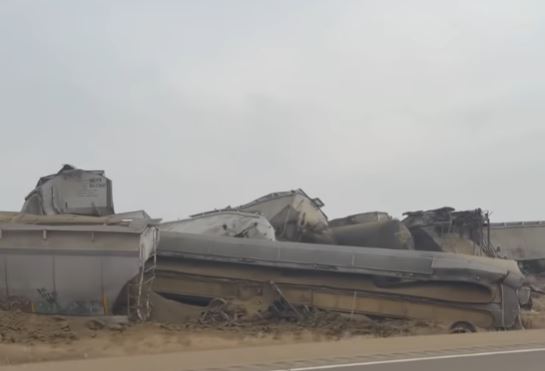
I spent yesterday speaking with residents and officials in Cranbrook after a freight train derailment sent several propane cars off the tracks just outside the city limits. The incident, which occurred early Monday morning, has raised significant concerns about rail safety in this mountainous region of southeastern British Columbia.
“I heard what sounded like thunder, but the sky was clear,” said Marianne Walters, who lives about two kilometers from the derailment site. “Then the emergency vehicles started racing past my house.”
According to the Transportation Safety Board of Canada, six rail cars carrying propane left the tracks at approximately 4:30 a.m. First responders quickly established a 400-meter safety perimeter around the site, though officials confirmed no leaks were detected from any of the tankers.
Canadian Pacific Kansas City Railway (CPKC) spokesperson Andrea Cobb told me the company immediately dispatched hazardous materials specialists to assess the situation. “Our emergency response protocols were activated within minutes of the incident,” she said. “Crew safety is our first priority, followed by environmental protection measures.”
The derailment location sits near a critical watershed that supplies drinking water to several communities in the East Kootenay region. Environmental testing crews have been sampling soil and water since the incident, with preliminary results showing no contamination.
Cranbrook Mayor Wayne Price expressed frustration about how long it took to receive official information. “We had to make decisions about potential evacuations with limited details,” he said during an emergency council meeting I attended last night. “The communication protocols between the railway and local government need serious improvement.”
This marks the third derailment in British Columbia this year, following incidents near Revelstoke in January and another outside Prince George in March. None resulted in injuries or major environmental damage, but the frequency has alarmed safety advocates.
Rail safety expert Jennifer Ohman from the University of British Columbia points to the challenging terrain as a contributing factor. “The mountainous routes through B.C. present unique challenges for rail transport,” she explained during our phone interview. “Extreme temperature variations, heavy precipitation, and steep grades all increase derailment risks.”
Statistics from Transport Canada show a 12% increase in dangerous goods incidents on Canadian railways over the past three years. The agency has promised a comprehensive review of safety regulations, but many local officials feel the process moves too slowly.
Regional Chief Ralph Pierre of the Ktunaxa Nation, whose traditional territory includes the derailment site, expressed concern about ongoing environmental impacts. “These tracks cross dozens of sensitive ecosystems within our lands,” he told me. “Each incident threatens our water, wildlife, and cultural resources.”
At the derailment site, cleanup crews expect to work through the weekend to remove the damaged cars and repair the tracks. CPKC estimates service will resume by Monday, though investigation teams from the Transportation Safety Board will remain longer.
For Cranbrook residents, the incident revives uncomfortable questions about the goods traveling through their community daily. A 2023 Transport Canada report indicates nearly 30% of rail shipments through the Southern Mountain corridor contain dangerous materials, from propane and crude oil to industrial chemicals.
“We’re a railway town, always have been,” said 63-year-old former railworker Tom Brennan, who I met at the local diner where residents gathered to discuss the incident. “But we deserve to know what’s rolling past our homes and that proper safeguards are in place.”
Provincial Minister of Transportation Rob Fleming issued a statement pledging cooperation with federal authorities on the investigation. His office confirmed that inspectors from both levels of government are now on site.
The economic impact of the disruption extends beyond Cranbrook. The affected rail line serves as a vital link for goods moving between Pacific ports and Canada’s interior. Alternative routes add significant time and cost, according to the B.C. Trucking Association.
As darkness fell over Cranbrook last night, the glow of work lights illuminated the derailment scene where crews continued their careful efforts to right the massive propane tankers. For a community built around the railway, the incident offers an unsettling reminder of the balance between economic necessity and public safety.
The Transportation Safety Board expects to release preliminary findings next week, though comprehensive investigation reports typically take months to complete. Whether this incident will prompt regulatory changes remains to be seen, but the conversation in Cranbrook coffee shops and council chambers suggests the community’s patience for “business as usual” may be running thin.