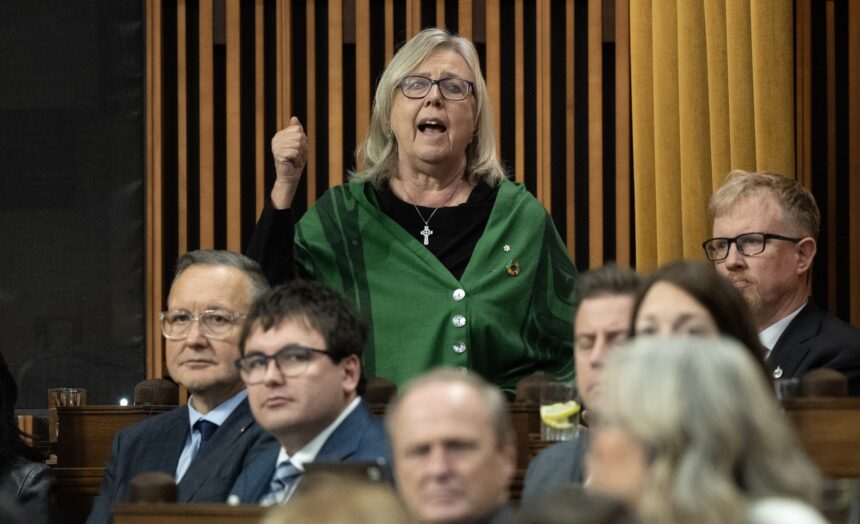
Elizabeth May’s recent admission that supporting the federal budget was “a mistake” has sent ripples through Parliament Hill, raising questions about the Green Party’s independence and potentially reshaping dynamics within the confidence-and-supply agreement landscape.
“I will never again vote for something I don’t support,” May told reporters yesterday during an impromptu media scrum outside the House of Commons. The Green Party leader and long-time MP for Saanich-Gulf Islands expressed visible frustration, acknowledging her decision to back the government’s fiscal plan last month contradicted core Green principles on climate action funding.
The dramatic reversal comes just three weeks after May stood in the House to cast her vote alongside Liberal MPs, despite what she now describes as “significant reservations” about insufficient climate investments and continued fossil fuel subsidies.
Political observers note this rare public self-critique reveals the challenging position smaller parties face in Canada’s parliamentary system. “When you’re leading a party with two seats, every vote becomes a statement of values,” explains Dr. Samantha Chong, political scientist at Carleton University. “May clearly feels she compromised those values for practical considerations.”
Sources close to the Green caucus suggest May had initially hoped her support might leverage future climate policy concessions. That calculation appears to have backfired, with the admission now prompting questions about the party’s strategic approach.
The budget, which passed 178-151, would have cleared Parliament without May’s support, making her reversal largely symbolic yet politically significant.
“I’m hearing from constituents who feel betrayed,” May acknowledged. “They elected me to champion bold climate action, not compromise on it. That criticism is fair.”
The timing is particularly sensitive given recent polling showing environmental concerns rising among Canadian voters. A Probe Research survey released last week indicates 64% of Canadians now rank climate change among their top three voting issues – up 7 points since February.
For Prime Minister Justin Trudeau’s minority government, May’s public distancing adds another complication to an already precarious parliamentary math problem. Liberal strategists had viewed occasional Green support as helpful, if not essential, to their legislative agenda.
“The Liberals counted May as a reliable partner on certain files,” notes veteran parliamentary correspondent Ella McPherson. “This statement essentially puts them on notice that such support can no longer be assumed.”
New Democrat MPs, who maintain their own confidence-and-supply agreement with the Liberals, have seized the opportunity to differentiate themselves. “Unlike others, when we negotiate for Canadians, we deliver,” NDP House Leader Peter Julian told reporters, in a thinly veiled reference to May’s situation.
The admission has particular resonance in British Columbia, where both Green MPs hold their seats. Local environmental organizations had expressed disappointment with May’s initial budget vote, with Victoria-based Climate Action Network coordinator Jacob Williams calling it “inconsistent with the urgency of the climate crisis.”
May’s pledge never to repeat what she terms her “mistake” signals a potential hardening of positions as Parliament approaches its final year before a mandated election. Political analysts suggest this could force the Liberals to work harder for cross-party support on upcoming legislation.
“This changes the calculus for the government,” says former parliamentary budget officer Melissa Thompson. “With the Greens potentially becoming less reliable partners, every confidence vote becomes more complicated.”
May, first elected in 2011, has built her reputation on principled stands, sometimes at political cost. Her candid acknowledgment appears calculated to restore trust with her base while signaling independence from Liberal policy positions.
For everyday Canadians watching the parliamentary chess match, May’s reversal offers a rare glimpse into the inner conflict politicians face between pragmatic compromise and core principles.
“I’ve been doing this long enough to know when to admit a mistake,” May concluded in her remarks. “My constituents deserve that honesty, even when it’s uncomfortable.”
Whether this mea culpa helps or hurts the Greens’ electoral prospects remains uncertain, but it undoubtedly adds another dimension to an increasingly complex parliamentary environment as Canada heads toward the next federal election.