The biting November wind cuts through the veterans’ jackets as they pause along Highway 1 just outside Banff. One man adjusts his prosthetic leg, grimacing slightly before straightening up with a nod to his companions. They’ve been walking for 53 days now, having left Victoria in early September. Their destination: Ottawa, still over 2,500 kilometers away.
This scene never happened in 2023. But a strikingly similar journey occurred exactly 105 years ago, when a group of World War I amputee veterans embarked on a cross-country trek to demand better support from a government they felt had abandoned them after their sacrifice.
“When we talk about remembrance in Canada, we focus on battlefield heroics, but seldom on what happened when these men came home,” says Dr. Corinne McConnery, historian at the University of British Columbia who specializes in veteran affairs. “The amputee march of 1919-1920 represents one of the most powerful but least remembered protests in Canadian history.”
In December 1919, twelve veterans—each missing at least one limb from war injuries—departed Vancouver with minimal supplies and fierce determination. Their leader, Captain Edward Baker, who lost his sight at Ypres, had grown frustrated with the Veterans Department’s refusal to increase disability pensions that had become woefully inadequate amid post-war inflation.
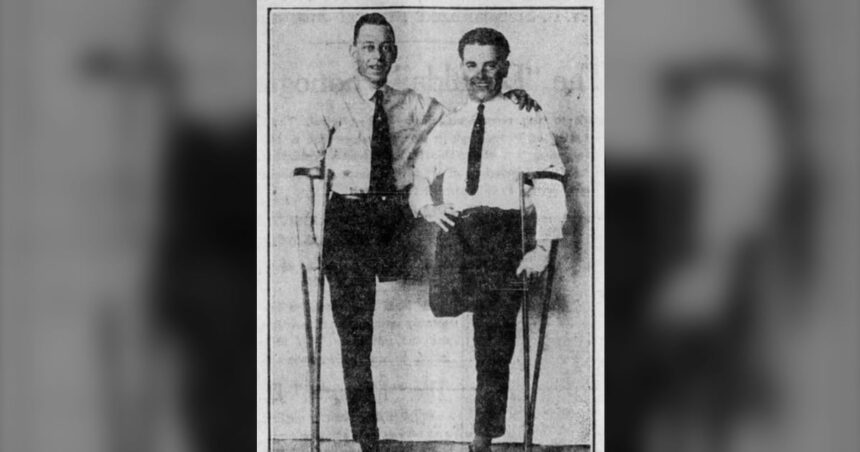
I visited the Vancouver Archives last spring where fragments of their journey remain preserved in yellowed newspaper clippings and a handful of photographs. One image shows the men departing, crutches and primitive prosthetics visible, faces set with determination rather than despair.
“These men walked through a Canadian winter on First World War-era prosthetics,” explains James Covington, curator at the Canadian War Museum. “Modern veterans would find today’s carbon-fiber prosthetics challenging enough for such a journey. These men were using wooden legs with leather straps and minimal padding.”
The veterans’ trek occurred during a pivotal moment in Canadian history. The country had just contributed more than 600,000 soldiers to the Great War—an astonishing number for a nation of barely 8 million. Over 66,000 never returned, and more than 172,000 were wounded. Among those, approximately 3,500 Canadian soldiers became amputees.
Government records from the Department of Soldiers’ Civil Re-establishment show that in 1919, a veteran who had lost one leg received between $480 and $600 annually—equivalent to about $7,500 in today’s currency. For many, this meant poverty.
“The march wasn’t just about money,” says Vivian Maracle, whose grandfather participated in the trek after losing his right arm at Vimy Ridge. I met Maracle at her home in Kingston, surrounded by her grandfather’s medals and a few precious photographs. “It was about dignity. These men had given parts of themselves for Canada, only to return to a country that seemed eager to forget their sacrifice.”
The march captured public attention as the veterans trudged through communities across British Columbia and the Prairies. In some towns, they were greeted as heroes, with residents offering meals and shelter. In others, their presence created uncomfortable reminders of war’s brutal aftermath that many preferred not to confront.
By February 1920, when they reached Winnipeg, the group had grown to nineteen men, with additional amputee veterans joining from prairie communities. Newspaper coverage shows how their journey increasingly focused national attention on veterans’ issues.
The Regina Leader-Post described their arrival: “Bearing visible marks of their sacrifice, these men ask not for charity but for justice. Their march through snow and bitter cold stands as testament to both their physical courage and the depth of their conviction.”
After 157 days on the road, the veterans arrived in Ottawa on May 3, 1920. They were initially rebuffed by Prime Minister Arthur Meighen’s office but gained a meeting after staging a silent vigil outside Parliament. Photographs from that day show the men standing in formation, their missing limbs impossible to ignore in the shadow of the Peace Tower.
The government eventually agreed to increase disability pensions by 12 percent and establish a commission to examine veterans’ reintegration challenges. While modest, these concessions established precedents that would influence veterans’ care for generations.
“What’s remarkable is how this story has fallen through the cracks of our collective memory,” says Dr. McConnery. “It fundamentally changed how we approach veterans’ care in Canada, yet isn’t taught in schools or acknowledged in Remembrance Day ceremonies.”
The journey of these amputee veterans resonates today. Recent Statistics Canada data shows modern veterans continue facing employment barriers and mental health challenges at higher rates than the general population. A 2022 report from Veterans Affairs Canada revealed that 25% of modern veterans report difficulty transitioning to civilian life.
Walter Hammond, a Canadian Forces veteran who lost his leg in Afghanistan in 2007, sees direct parallels. “When I learned about the 1920 march, it hit home. Different war, different century, but some of the same battles for recognition and support. We stand on their shoulders.”
Next year, a coalition of veterans’ organizations plans to commemorate the original march with a ceremonial relay across Canada. Participants will carry a single crutch—a replica of one used in the original journey—now preserved in the Canadian War Museum.
As Remembrance Day approaches, the forgotten trek of these determined veterans offers a different perspective on what we choose to memorialize. Beyond the battlefield heroics lies this quieter courage—the long journey home and the fight for dignity that continued long after the guns fell silent.
“They literally walked across a country to be seen,” Maracle tells me as she carefully returns her grandfather’s photograph to its frame. “The least we can do is remember them.”