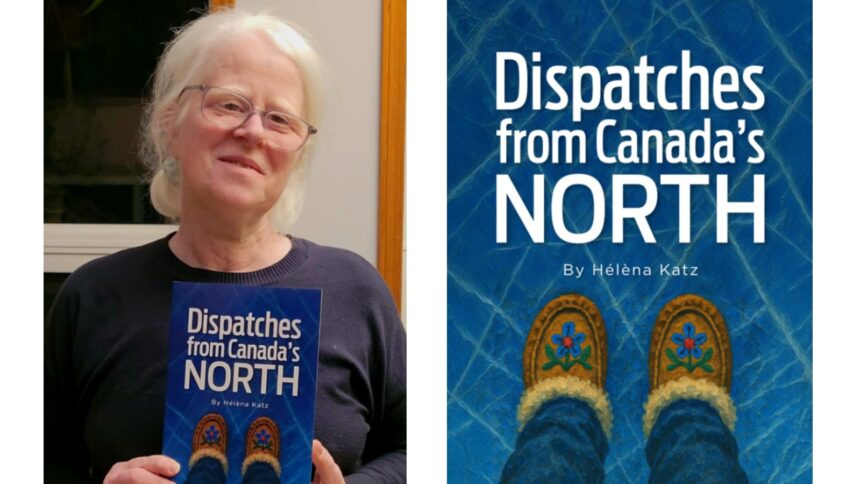
I stood on the shore of the Slave River, watching a group of paddlers navigate the treacherous rapids. The evening sun cast long shadows across Fort Smith, illuminating the town that sits at the border between Alberta and the Northwest Territories. It’s places like this—where wilderness and community intertwine—that Helena Katz has called home for over three decades.
“I never imagined I’d be here this long,” Katz told me, laughing as we settled into a quiet corner of the Northern Life Museum. “When I first arrived, I thought I’d stay maybe two years.”
Katz’s journey from Montreal to Canada’s North forms the backbone of her newly released collection of essays, “Northern Heart: Essays on Finding Home at the Edge of the Wilderness.” The book chronicles her evolution from a self-described “city girl” experiencing severe culture shock to becoming an integral part of the northern community fabric.
At 72, Katz speaks with the measured cadence of someone who has spent years observing before speaking—a skill she honed as a CBC radio journalist in the North. Her collection spans decades of lived experience, from her early days adjusting to -40C temperatures to her deep connections with Indigenous elders who shared traditional knowledge.
“When I arrived in 1989, I couldn’t have found Fort Smith on a map,” she admitted. “I came for work, but I stayed because of the people and the land. There’s a directness here, a genuineness that gets under your skin.”
The book doesn’t romanticize northern living. Katz writes candidly about isolation, limited resources, and the sometimes-challenging community dynamics in a town of roughly 2,500 people. But it’s her exploration of belonging that resonates most powerfully.
“Helena captures something essential about the North that outsiders often miss,” said Mary Powder, a longtime Fort Smith resident and friend of Katz. “She writes about us without making us exotic. We’re just people living our lives in a place that happens to be further north than most Canadians ever venture.”
Katz’s essays touch on profound shifts in northern life—the impacts of climate change on traditional hunting patterns, the ongoing work of reconciliation between Indigenous and non-Indigenous residents, and the technological revolution that has transformed even the most remote communities.
The collection’s most moving pieces center on relationships. Katz writes about friendship with Dene and Métis elders who accepted her questions and offered knowledge about the land. One essay details her friendship with Elder Jane Dragon, who taught Katz traditional skills like hide tanning and medicinal plant identification.
“Jane would just laugh at my city hands,” Katz recalled. “She’d say, ‘You’ll toughen up.’ And eventually, I did.”
According to Statistics Canada, just 0.3% of Canada’s population lives in the three territories, despite them comprising roughly 40% of the country’s landmass. This disconnect between southern and northern Canada creates persistent misconceptions about life in communities like Fort Smith.
Climate change figures prominently in several essays. The North is warming at nearly three times the global average rate, according to Environment and Climate Change Canada, transforming ecosystems and challenging traditional ways of life.
“I’ve watched the ice on the river change its patterns over 30 years,” Katz explained. “Elders who read ice conditions to determine safe travel say it’s becoming increasingly unpredictable.”
Despite these challenges, her book avoids the twin pitfalls of over-romanticizing or catastrophizing northern life. Instead, it offers textured portraits of resilience and adaptation.
Local publisher Tundra Books took on the project after Katz had collected her essays, many previously published in northern magazines like Up Here and Edge YK. The launch at Fort Smith’s public library drew a cross-section of the community—longtime residents, newcomers, and several generations of families who appear in Katz’s stories.
“What makes Helena’s writing special is that she never stopped being curious,” said Tom Unka, a Denesuline elder who features in one of the essays about traditional fishing practices. “Many people come North and think they know us after a year. Helena is still learning after thirty years.”
For younger northerners, the book offers a bridge to understanding how their communities have evolved. Eighteen-year-old Sophia Cardinal, born and raised in Fort Smith, said reading the collection gave her perspective on her hometown.
“My generation takes for granted things that were huge adjustments for people like Helena,” Cardinal remarked. “Reading about how Fort Smith looked when she arrived helps me see how much has changed, but also what’s stayed the same.”
As our conversation winds down, Katz points through the museum window to where children play in a park bordered by boreal forest. “That’s what I hope readers take away—this isn’t the end of Canada. It’s the beginning of something else entirely.”
“Northern Heart: Essays on Finding Home at the Edge of the Wilderness” is available at independent bookstores across Canada and through the publisher’s website. Helena Katz will be touring several northern communities this summer, sharing stories from her decades of northern living and writing.
When I ask what’s next, Katz smiles. “I’m working on stories about northern gardening—how climate change is extending our growing season while creating new challenges. The North is never static. That’s what keeps me writing.”
As we walk back along the riverbank, I understand why she stayed all those years ago. There’s a quality to the light here, a vastness to the landscape, and a warmth to the community that makes even visitors like me contemplate what it might mean to find home in unexpected places.