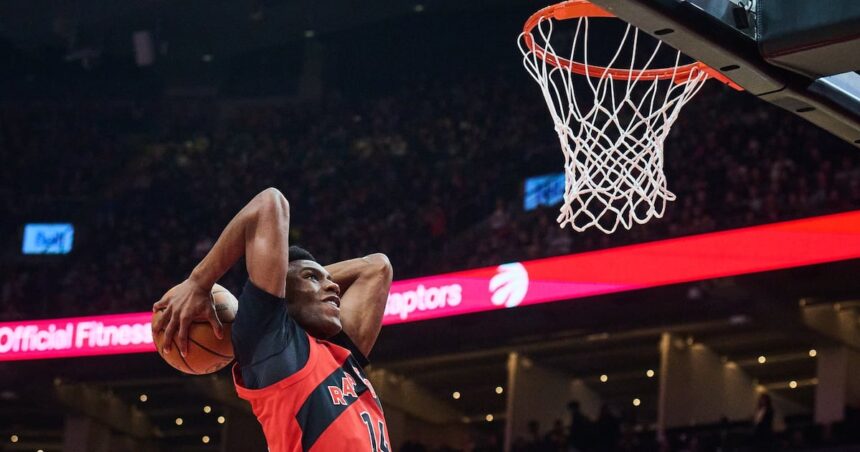
I stared down at my worn notebook as the maple-scented breeze floated through the open door of OVO Athletic Centre. November in Toronto carries that distinct chill—not quite winter, but no longer fall—and inside, the rhythmic pounding of basketballs against hardwood created its own heartbeat.
“The biggest adjustment? Definitely the speed,” Ja’Kobe Walter told me, wiping sweat from his brow after the Raptors’ morning shootaround. “Everyone’s faster, stronger. But I’m finding my spots now.“
Finding his spots might be an understatement. The rookie guard has emerged as one of the more intriguing stories in what has become a season of transition for Toronto. After struggling with his shot through October, Walter has connected on 41% of his three-point attempts over his last twelve games—a dramatic improvement that has coaching staff and teammates taking notice.
“He’s always had that confidence,” said veteran guard Immanuel Quickley. “But now you’re seeing him make reads, understanding when to take that shot and when to make the extra pass. That’s growth you can’t rush.”
I’ve been covering the Raptors since before their 2019 championship run, and I’ve witnessed the organization’s evolution through various eras. This current iteration—rebuilding while developing young talent—requires patience from both fans and players. Walter embodies that process.
Selected 19th overall in this year’s draft out of Baylor University, Walter arrived in Toronto with a reputation as a defensive specialist with shooting upside. His college numbers (14.5 points per game on 34% from deep) hinted at potential, but few expected him to adapt so quickly to the NBA’s perimeter spacing.
“College basketball and the NBA are completely different games,” explained Raptors assistant coach Jama Mahlalela. “The three-point line is farther, defenders close out harder. Ja’Kobe put in tremendous work with our development staff on his release point and footwork.”
That work manifests in moments like last Tuesday’s game against Milwaukee, when Walter checked in with the Raptors down eleven points in the third quarter. He proceeded to hit three consecutive corner threes, each one punctuated by his subtle celebration—a quick tap to his chest and point skyward.
According to NBA tracking data, Walter has improved his catch-and-shoot effectiveness from 31.2% in his first ten games to 43.7% over the past month. His shot chart shows particular improvement from the corners, where he’s now converting at an elite 46.8% clip.
The defensive foundation was always there. At 6’5″ with a 6’10” wingspan, Walter disrupts passing lanes and can guard multiple positions. His defensive rating of 107.4 ranks third among all rookies playing at least 20 minutes per game.
“Defense is non-negotiable here,” Walter said, echoing the longstanding mantra of Raptors basketball. “Coach made that clear from day one. If I’m not bringing it defensively, I won’t see the floor.”
Walking through Scotiabank Arena before a recent home game, I noticed more fans wearing Walter’s #23 jersey—still not approaching the popularity of Scottie Barnes or RJ Barrett, but growing. There’s something about the way Walter plays—all hustle and determination—that resonates with Toronto’s basketball identity.
“People underestimate the mental aspect,” Walter explained when I asked about his improved shooting. “Early on, I was overthinking everything. Now I’m just playing basketball again, trusting my preparation.”
That preparation includes daily shooting sessions with player development coach Fabulous Flournoy, often staying an hour after team practices end. The routine involves high-volume three-point shooting from five different spots, with a focus on game-speed repetitions.
Sports psychologist Dr. Kensa Gunter, who consults with several NBA teams, notes this is typical of successful adjustment periods for rookies. “There’s often that initial struggle as players adapt to the professional level,” she told me in a recent interview. “The ones who break through combine physical skill development with mental adjustments—learning to play through mistakes and building confidence through repeated success.”
Walter’s emergence has coincided with improved bench production for Toronto. The Raptors’ second unit, which struggled offensively early in the season, now outscores opponents by 3.2 points per 100 possessions when Walter is on the floor.
“He’s become that spark we need,” head coach Darko Rajaković said after yesterday’s practice. “His energy is contagious. When he hits a shot or makes a defensive play, you can feel the whole bench get energized.”
In the locker room, veteran players have embraced Walter’s work ethic. Chris Boucher, in his sixth season with Toronto, has taken a mentorship role with the rookie.
“This league will humble you quick,” Boucher said. “Ja’Kobe had some tough games early, but he never stopped working. That’s what we respect—he puts in the time.”
As Walter’s minutes gradually increase—he’s now averaging 24.7 minutes over the last eight games—the question becomes how high his ceiling might be. While some rookies plateau after initial improvements, Walter’s trajectory suggests sustainable development.
“I’m nowhere near where I want to be,” he insisted as our conversation wrapped up. “The shooting is better, sure, but I’m still learning how to create for others, how to be a complete player.”
The afternoon sun filtered through the practice facility windows, casting long shadows across the court. Walter picked up a basketball, spun it in his hands, and smiled.
“Toronto believed in me when others didn’t. I owe it to the city and this organization to maximize everything I’ve got.“
For a team and fanbase navigating the uncertain waters of rebuilding, Walter’s emergence offers something potentially more valuable than immediate wins—it offers promise.