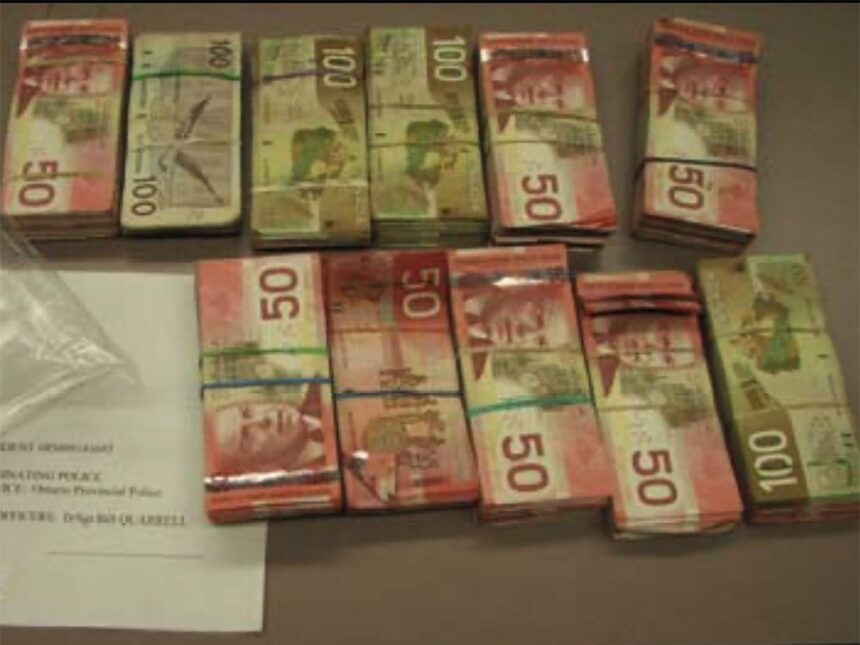
I’ve been combing through Ontario court records for months, following a most peculiar case that raises serious questions about how police seize assets and what rights property owners have when challenging these seizures.
Last week, Justice Peter Hockin of the Ontario Superior Court ruled that approximately $1 million in cash—literally buried in plastic containers on a rural property—would remain in government hands despite the collapse of the criminal case against its purported owner.
The ruling stems from a 2018 police raid in southwestern Ontario where officers, acting on a confidential informant’s tip, discovered several buried containers filled with Canadian and U.S. currency on property belonging to Joseph Sarhan. The raid initially led to drug trafficking charges against Sarhan, but those charges were later withdrawn due to what his attorney describes as “significant Charter violations during the search.”
“This case sits at the uncomfortable intersection of civil forfeiture laws and criminal procedure,” said Emma Davidson, a civil liberties attorney I spoke with who has handled similar cases. “When criminal charges fail but the government keeps the property anyway, we have to question whether the system is functioning as intended.”
Court documents I reviewed show that officers discovered the cash buried in multiple locations on Sarhan’s 10-acre property. Photos entered as evidence depict plastic containers wrapped in garbage bags, containing neatly bundled bills. The money showed traces of soil and moisture damage but was largely intact.
The Ontario Civil Remedies Act, enacted in 2001, allows authorities to seize property believed to be proceeds of unlawful activity, even without a criminal conviction. Critics have long argued this creates a system where property owners face a reverse onus—they must prove their possessions aren’t crime-related, rather than the government proving they are.
Professor Alan Young from Osgoode Hall Law School told me this creates an “end-run around criminal due process protections.” In our interview, he explained: “Civil forfeiture operates on the balance of probabilities, not beyond reasonable doubt. When criminal charges collapse but forfeiture proceeds anyway, it suggests the government is using civil procedures to accomplish what it couldn’t criminally.”
I spent three days in the courthouse reviewing the case file. Justice Hockin’s 42-page decision hinges on what he deemed “compelling circumstantial evidence” that the buried cash came from illegal activities, despite acknowledging there was insufficient evidence to sustain criminal charges.
Sarhan’s defense team argued vigorously that the money represented legitimate savings accumulated over decades of business dealings. They presented tax records and business transaction histories, but the court found these explanations “implausible given the manner of storage and concealment.”
“Burying cash in your backyard isn’t illegal,” said Sarhan’s attorney, Michael Lacy, when I interviewed him after the ruling. “Unusual, yes, but my client grew up in a country where banks weren’t trusted. The government exploited cultural differences and suspicion to keep money they seized in a constitutionally defective search.”
The case highlights a troubling pattern in Canadian asset forfeiture. According to a report by the Canadian Civil Liberties Association that I obtained, Ontario alone has seized over $150 million in assets since 2003. The report noted that many cases never result in criminal convictions, yet property is rarely returned.
Sarhan’s experience follows a familiar trajectory. After police executed their warrant, they seized not only the buried cash but computers, vehicles, and other personal items. When the criminal charges were withdrawn two years later due to Charter violations in how the search was conducted, Sarhan expected his property returned. Instead, the Attorney General pursued civil forfeiture.
“The government gets to fail in criminal court but still keep everything they took,” said Lacy. “It makes the Charter protections meaningless if the state can simply pivot to civil proceedings after constitutional violations.”
What makes this case particularly noteworthy is the government’s successful argument that the money’s burial itself constituted evidence of criminality. The court accepted that “legitimate funds aren’t typically stored in plastic containers underground,” creating a precedent that unusual banking practices might suggest illegal activity.
For immigrant communities where distrust of financial institutions runs deep, this reasoning raises alarms. Nadia Ibrahim from the Cross-Cultural Legal Advocacy Project told me, “Many newcomers keep cash at home based on experiences in their countries of origin. This shouldn’t automatically trigger suspicion.”
The financial intelligence unit FINTRAC estimates that Canadians hold approximately $5 billion in cash outside the banking system. While much represents day-to-day transactions, cultural practices around cash savings persist across multiple communities.
Justice Hockin acknowledged these concerns but ultimately found that the “totality of circumstances” surrounding Sarhan’s buried wealth—including its packaging, distribution across the property, and lack of documentation—tipped the scales toward forfeiture.
Sarhan has 30 days to appeal the decision. His legal team indicated they’re considering this option, particularly given the precedent this case could set for civil forfeiture proceedings following failed criminal prosecutions.
Whatever happens next, this case leaves a disturbing question: If police violate your rights during a search and criminal charges collapse as a result, should the government still keep what they found? For Joseph Sarhan and his buried fortune, the answer—at least for now—is yes.