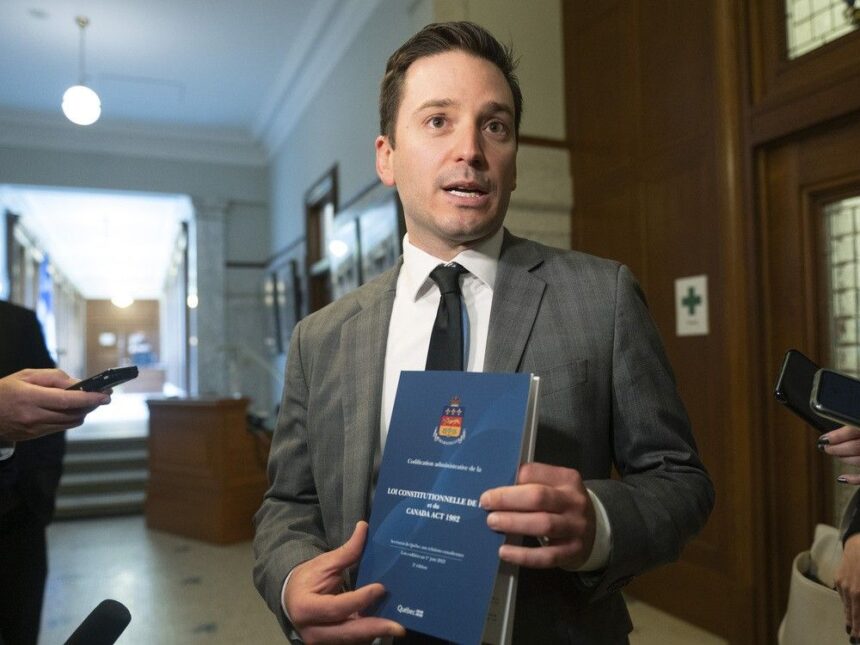
Quebec’s Justice Minister Simon Jolin-Barrette unveiled a draft constitution for the province yesterday, describing it as “a reflection of who we are as a people.” The 55-page document outlines expanded powers for Quebec while explicitly avoiding language that would pave the way toward independence from Canada.
Standing at the National Assembly podium, Jolin-Barrette emphasized this distinction. “This is about greater autonomy within the Canadian federation, not separation,” he told reporters, addressing concerns from federal officials who have watched Quebec’s constitutional maneuvers with wariness since the referendum battles of the 1990s.
The draft constitution represents the latest chapter in Quebec’s decades-long pursuit of distinct status within Canada. Unlike previous efforts that centered on sovereignty, this document focuses on practical governance powers while affirming Quebec’s place in the Canadian federation.
I’ve spent the last three days speaking with constitutional experts, community leaders, and everyday Quebecers about what this means for the province’s relationship with Ottawa. What emerges is a complex picture of a society seeking to protect its cultural and linguistic uniqueness while avoiding the economic and political turbulence that could come with separation.
“This isn’t your grandfather’s separatist movement,” says Dr. Élise Fortier, constitutional scholar at Université Laval. “The CAQ government is taking a pragmatic approach – securing more decision-making power on issues that matter to Quebecers while acknowledging the practical benefits of remaining in Canada.”
The draft constitution would formalize Quebec as a nation within Canada while seeking greater control over immigration, taxation, and environmental regulation. Notably, it would enshrine French as the sole official language and recognize the province’s distinct civil law tradition.
In Trois-Rivières, where I met with community members at a local café, opinions were divided but thoughtful. “We need to protect our culture and language, but full independence doesn’t make economic sense anymore,” said Marcel Tremblay, 67, a retired factory worker who voted for separation in the 1995 referendum.
Younger Quebecers seemed less concerned with constitutional questions and more focused on practical issues. “I care more about housing affordability and climate action than whether we have more constitutional powers,” said Sophie Dion, 29, a software developer in Montreal.
The timing is significant. Premier François Legault’s Coalition Avenir Québec government has seen its popularity decline since winning a strong majority in 2022. Recent polling from Léger shows CAQ support at 30%, down from 41% in the last election. Some political analysts suggest this constitutional initiative may be designed to rally nationalist support without alienating federalist voters.
Federal reaction has been cautious. Prime Minister Justin Trudeau acknowledged Quebec’s right to define its identity but noted that any constitutional changes affecting federal powers would require broader negotiation. “We respect Quebec’s distinct society and its desire to preserve its language and culture,” Trudeau said during a press conference in Ottawa. “But Canada’s constitution belongs to all Canadians.”
The draft includes several provisions that would directly challenge federal authority, including:
– Greater control over immigration selection and integration
– Provincial oversight of telecommunications
– Expanded taxation powers
– Constitutional veto power over federal changes affecting Quebec
Daniel Béland, director of the McGill Institute for the Study of Canada, told me these demands reflect a strategic shift. “The CAQ is not seeking separation but maximum autonomy – what we might call sovereignty-association without the sovereignty part.”
In Quebec City’s historic Petit Champlain district, I spoke with small business owners who expressed pragmatic views on the constitutional question. “Quebec needs to protect its unique character, but our economy is deeply connected to Canada and the United States,” said Jean-Philippe Mercier, who owns a tourism company. “Most of my customers come from outside Quebec.”
The province’s business community has generally supported increased autonomy while expressing concern about potential economic disruption. The Chamber of Commerce of Metropolitan Montreal issued a statement calling for “constitutional clarity that respects Quebec’s distinctiveness while maintaining economic integration.”
Opposition parties in Quebec have responded differently to the draft. The Parti Québécois criticized it as not going far enough toward sovereignty, while Quebec Liberal Party leader Marc Tanguay questioned whether constitutional discussions should take priority over healthcare and inflation concerns.
What makes this initiative different from previous constitutional efforts is its incremental approach. Rather than demanding immediate recognition through constitutional amendments, the CAQ government plans to implement aspects of the draft through ordinary legislation, particularly Bill 96, which has already strengthened French language requirements.
“It’s sovereignty by a thousand cuts,” explained political strategist Marie-Claude Savard. “Instead of seeking dramatic change through a referendum, they’re gradually accumulating powers through legislation, court challenges, and intergovernmental agreements.”
For everyday Quebecers, constitutional debates often feel removed from daily concerns. At a community center in Saguenay, Jeanne Tremblay, 42, a nurse and mother of two, expressed fatigue with identity politics. “We’ve been having these debates since before I was born. Meanwhile, I can’t find a family doctor for my kids, and housing costs keep rising.”
Yet identity questions remain powerful in Quebec society. The province’s relationship with its Indigenous communities adds another layer of complexity. The draft constitution acknowledges Indigenous rights while maintaining provincial authority over resources and territory – a position some First Nations leaders have already criticized.
As Quebec moves forward with its constitutional vision, the question remains whether this initiative represents a new equilibrium in Quebec-Canada relations or merely the latest chapter in an unresolved story. The draft will undergo public consultation before final adoption, leaving room for amendments and compromise.
Whatever the outcome, this constitutional initiative reflects Quebec’s ongoing desire to define itself on its own terms while navigating the practical realities of 21st century governance in a federal system.